If your child hears the word lesson and immediately loses interest, you’re not alone.
Most kids don’t learn English by sitting down, repeating words, or filling in worksheets. They learn when they’re relaxed. When they’re moving. When they’re playing.
That’s why playtime is one of the easiest — and most powerful — ways to use English at home.
And the best part? You don’t need to be fluent. You don’t need a plan. You don’t need to “teach” at all.
Why Play Works Better Than Lessons
Children learn language through use, not explanation.
When English shows up during play, it feels safe and familiar — not like something they can get wrong.
Play removes pressure for both kids and parents. You’re not correcting. You’re not testing. You’re just talking while something fun is happening.
Short moments of English during play, repeated often, do far more than long “lessons” that feel forced.
What “Teaching Through Play” Actually Looks Like
This isn’t about turning playtime into a secret classroom.
It’s about lightly adding English to what your child already loves doing.
You don’t need scripts. You don’t need translations. You don’t need to explain grammar.
You simply use a few familiar English words and phrases while playing — and let your child absorb them naturally.
Simple Ways to Use English During Playtime
1. Toy Play (Cars, Dolls, Animals)
Name what’s happening as you play.
“Red car.” “Big dog.” “Baby sleeping.”
Short, simple phrases are enough. Your child doesn’t need full sentences to learn.
2. Building Games (Blocks, LEGO, Puzzles)
Building naturally invites repetition.
“Put here.” “Up high.” “Oh no — fall down!”
You’re describing actions, not teaching vocabulary lists — and that’s exactly why it works.
3. Pretend Play
Pretend play is gold for language.
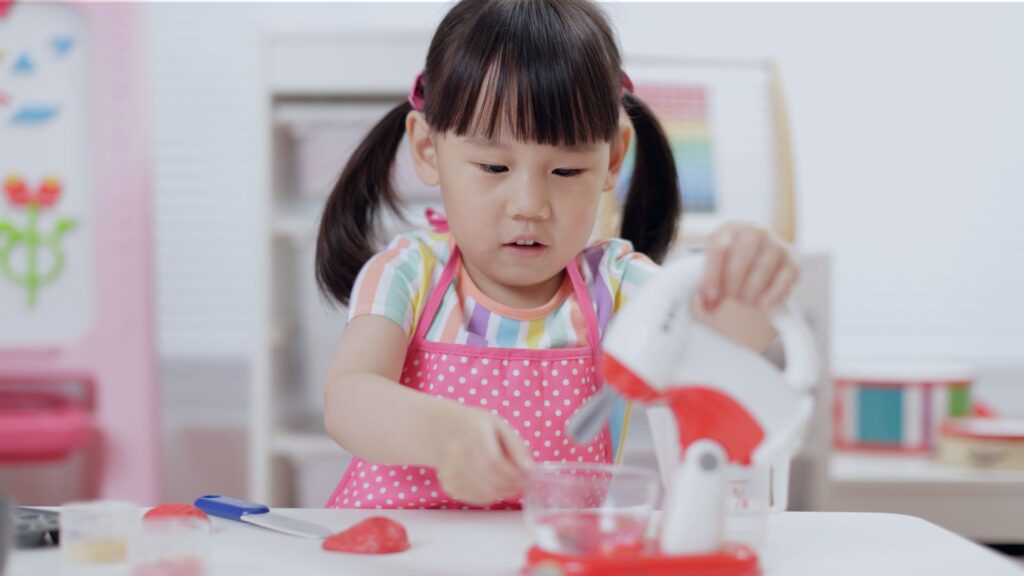
Cooking games, shops, doctors, families — all of these create natural reasons to speak.
“Your turn.” “Let’s eat.” “All done.”
Don’t worry about variety. Repeating the same phrases helps them stick.
4. Active Play
Running, jumping, dancing — movement helps language stick.
“Jump!” “Stop!” “Fast!” “Slow!”
These words become meaningful because your child feels them while moving.
5. Board Games and Simple Games
Games with turns are perfect for English.
“My turn.” “Your turn.” “Go again.”
You’re not explaining rules in English — just repeating the same useful phrases every time you play.
How to Keep It Easy (and Not Overthink It)
Pick one type of play your child already loves.
Choose just a few phrases.
Use them again and again.
Some days you’ll use more English. Some days none at all. That’s normal.
What matters is that English feels like part of life — not a performance.
Common Mistakes to Avoid
Trying to correct every word.
Stopping play to explain meanings.
Expecting your child to answer in English right away.
Language grows quietly first. Understanding comes before speaking.
You don’t need to turn playtime into a lesson for English to work.
A few relaxed words, repeated during moments your child already enjoys, are more than enough to build real understanding — slowly, naturally, and without pressure.
Don’t forget to check out more playtime ideas here.
If you ever need help or clarity, you can reach me through the contact page.